
The science of life.
Beyond boundaries.
A research-oriented initiative connecting human anatomy, physiology, physics and clinical computation—guided by scientific evidence and a wider view of life.
Biology is complex.
Understanding it changes everything.
From the architecture of organs and cells to bioelectric signals and clinical information, understanding life requires biology, physics and trustworthy computational methods working together.
↗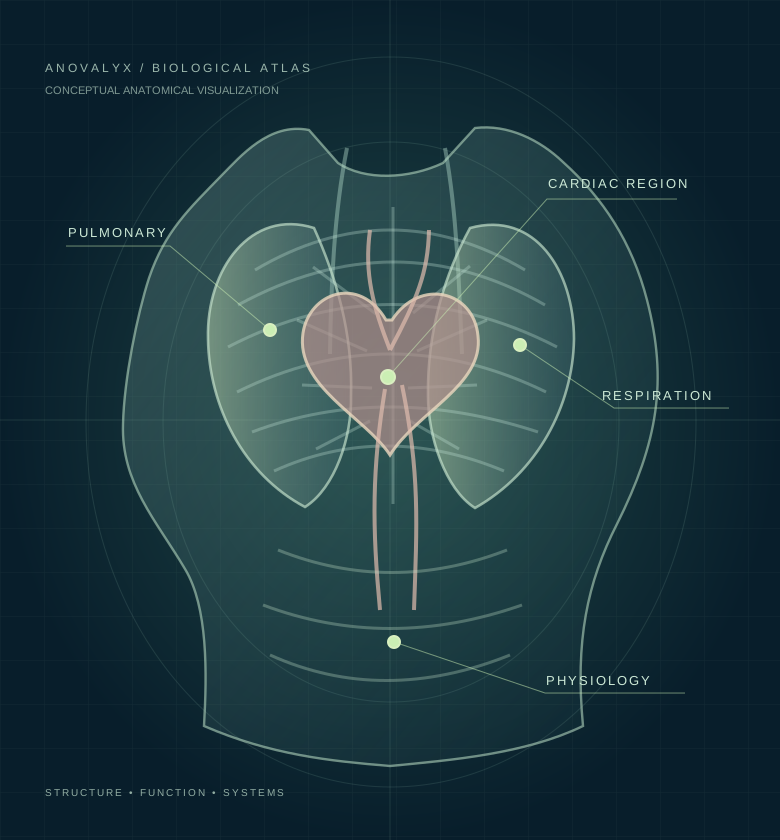 HUMAN ANATOMY • ILLUSTRATIVE, NOT DIAGNOSTIC
The human body.
A universe of systems.
Our scientific viewpoint begins with human structure and function: organs, tissues, neural systems, circulation and the physical processes that connect them.
Relating anatomical architecture to physiological activity.
Examining signals, pressure, motion, transport and measurement.
Using transparent models and software to organize complex observations.
Exploring life
across disciplines.
Six scientific themes connect anatomy, cellular mechanisms, biophysics, computation and the bigger planetary context.
Human Anatomy & Physiology
Examining how the body is organized, how organs interact and how physiological systems maintain balance.
Cellular & Molecular Biology
Considering the structures, mechanisms and dynamic processes that sustain living cells.
Biophysics & Biosignals
Connecting physical principles, physiological rhythms, waves and quantitative biological measurement.
Clinical Computing & Informatics
Studying how trustworthy software, standards and structured information support clinical understanding.
Computational Biology & Modeling
Combining biological knowledge, mathematics and reproducible computing to examine complex questions.
Life Science & Planetary Perspective
Using Earth, planetary environments and space exploration as a broader lens for studying life.
A closer look
through better tools.
Technology extends the questions we can ask of biology. Our areas of interest include anatomical visualization, biomedical signals, imaging, clinical information systems and reproducible computational models.
Explore research technology ↗ CELLULAR OBSERVATION
From biology
to meaningful data.
Anatomy and physiological science underpin responsible clinical software. Interoperability, imaging, verification and human oversight give computation its clinical context.
Explore clinical systems ↗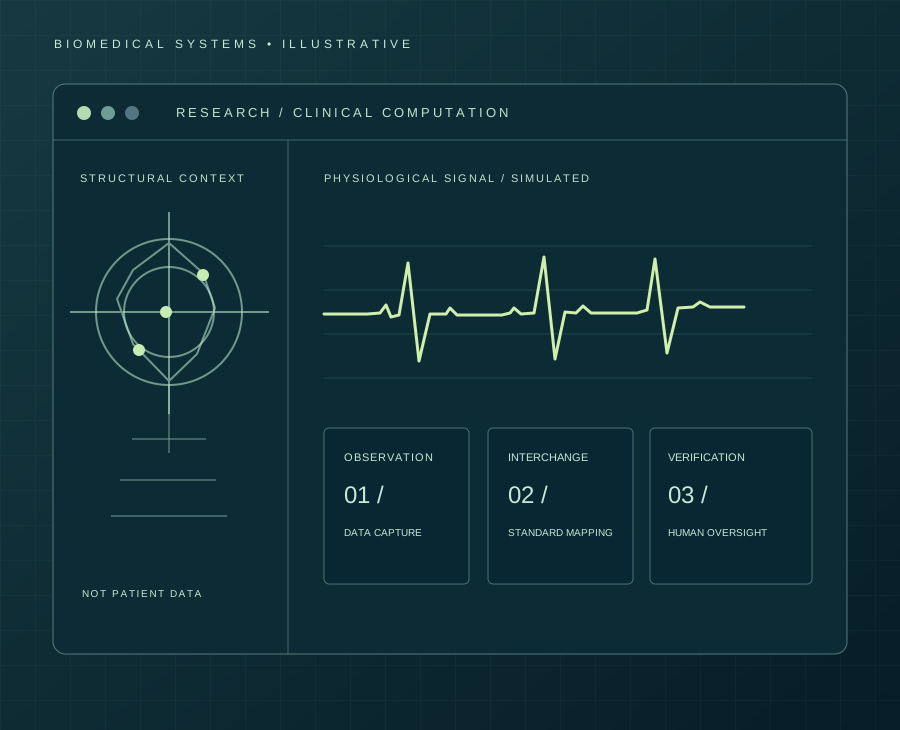
From observation
to reliable insight.
Good scientific questions are supported by reproducible methods, critical evaluation and an honest account of uncertainty.
Frame the question
Specify the biological question, scope, assumptions and evidence needed.
Observe carefully
Consider measurement quality, biological variability and appropriate controls.
Analyze critically
Use quantitative reasoning to assess hypotheses and alternative explanations.
Evaluate responsibly
Prioritize repeatability, transparency, ethics and clear limitations.
Look beyond Earth.
Study life more deeply.
The scale of the universe inspires perspective. Our scientific questions remain rooted in biology, evidence and the human experience.
Our purpose ↗Human science.
Cosmic perspective.
We study life from where it is known to exist: Earth. The wider universe offers context for physics, environmental biology and questions about how living systems respond to their surroundings.
Earth is home to human civilization. Mars represents a frontier of robotic exploration and future scientific inquiry—not an existing human settlement.
Explore the bigger questions ↗Ideas, methods
and perspectives.
Editorial reading on the science and technology of living systems. These are perspectives, not published experimental results.
Why anatomy still matters in an age of digital medicine
The connection between structural understanding, physiological context and responsible clinical software.
Read perspectivePhysics inside living systems: motion, signals and measurement
A scientific lens on pressure, bioelectricity, transport and the limits of measured signals.
Read perspectiveBuilding trustworthy clinical information systems
Why interoperability, privacy, verification and clinical context matter in medical computation.
Read perspectiveFrom cellular images to biological insight
Why visualizing living structures is only the beginning of a scientific investigation.
Read perspectiveReading biological signals responsibly
A measured look at variability, noise and context in biological signal research.
Read perspectiveWhy reproducibility belongs at the center of computational biology
Reliable biological computing begins with transparent data, assumptions and validation.
Read perspective